
Blog
The new mining industry
Technologies in mining 4.0 are changing the operational logic of the mineral sector. Instead of just optimizing processes and reducing costs, they promote a structural transformation in the way operations are planned, controlled, and improved
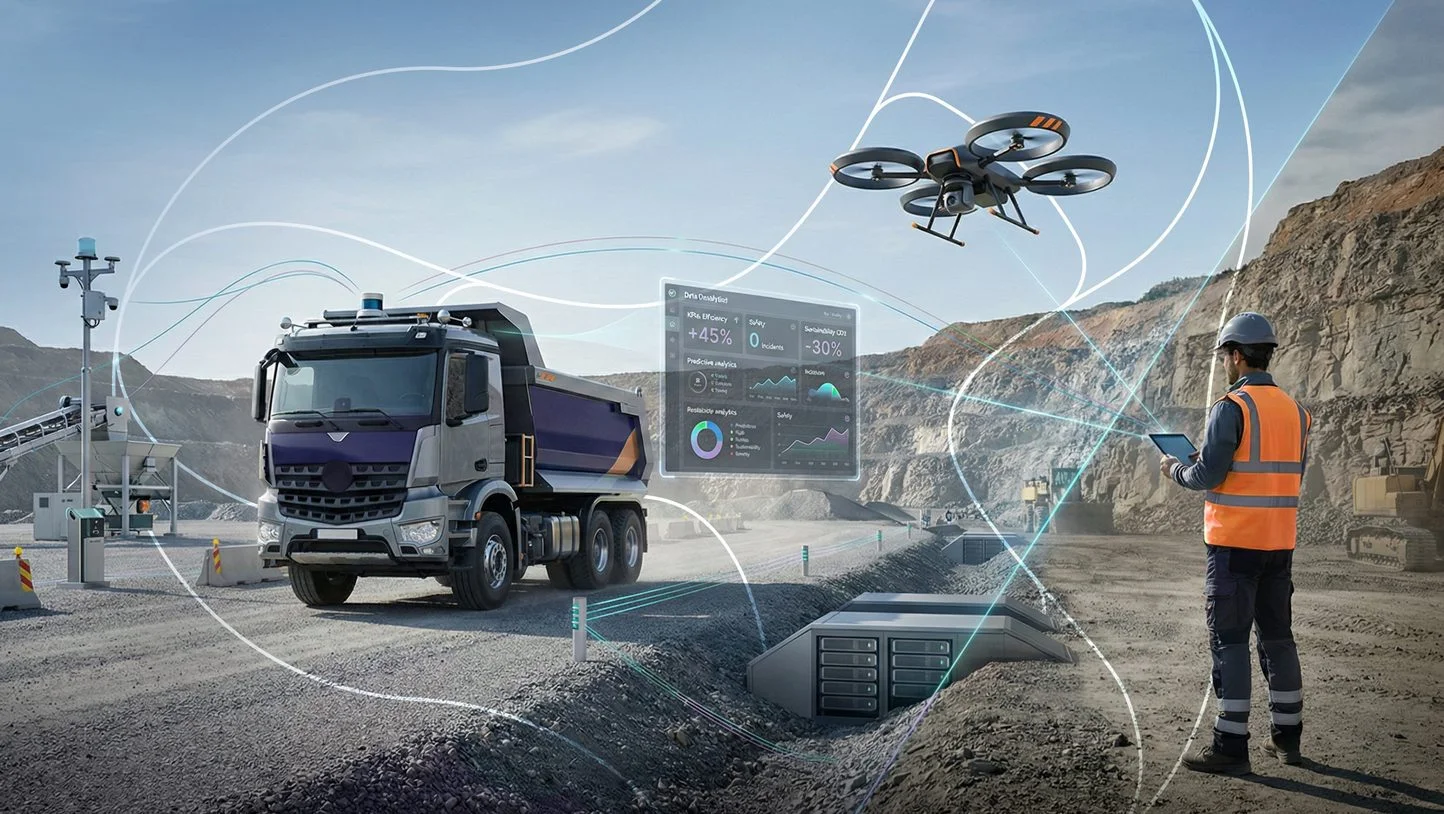
How AI, sensors, and automation platforms are revolutionizing the mineral segment
Technologies in mining 4.0 are changing the operational logic of the mineral sector. Instead of just optimizing processes and reducing costs, they promote a structural transformation in the way operations are planned, controlled, and improved.
Furthermore, digitization applied to mining connects data, engineering, and execution in real-time. As a result, decisions that once depended on long cycles are now made based on continuous monitoring and operational predictability.
What are mining 4.0 technologies
Directly, mining 4.0 technologies represent the integration of advanced digital solutions in high-complexity industrial environments. In other words, it is not an isolated tool, but a technological ecosystem that operates in layers.
In practice, the most common pillars include:
- Artificial Intelligence (AI)
- Sensors, cameras, and industrial radars
- Drones and robots
- Autonomous vehicles
- Automation and control platforms
As a result, mining evolves into a data-driven model, with greater capacity to anticipate events, reduce variability, and increase operational stability.
Benefits of mining 4.0 technologies in the operational chain
Although gains vary by mine type and digital maturity, benefits tend to appear consistently across four areas.
Operational efficiency with real-time data
First, sensors and automation platforms allow continuous monitoring of mines, machines, and equipment. Thus, bottlenecks become more visible and failures become predictable. Consequently, interventions can occur faster, including remotely.
Additionally, the operation begins to work with more stable indicators. In this way, delivery predictability increases and dependence on last-minute corrective actions is reduced.
Autonomous vehicles and maximum equipment availability
Next, autonomous vehicles, controlled by AI, raise the standard of operational continuity. Operating 24/7, they reduce the need for operators in critical areas and expand productivity.
At the same time, predictive maintenance evolves based on condition data. Therefore, equipment availability increases, energy and fuel consumption improves, and gas emissions are better controlled.
Safety based on prevention and simulation
From a safety standpoint, mining 4.0 reduces , and in some cases eliminates , the exposure of people in risk areas. For example, robots and drones can inspect critical areas, while sensors continuously assess air and water quality.
Furthermore, AI simulations help anticipate scenarios and risks. That is, safety stops being just a reaction and becomes operational prevention.
ESG and compliance with operational traceability
Finally, algorithms monitor the use of natural resources and point out deviations in near real-time. Likewise, they cross-reference current practices with regulations and internal standards. Thus, mining 4.0 technologies strengthen governance, compliance, and traceability of environmental and operational indicators.
Applications of mining 4.0 in practice
Mining 4.0 technologies in mineral exploration
In exploration, AI analyzes large volumes of geological data and identifies patterns and anomalies. This increases predictability regarding the presence and quality of the ore. As a result, the need for and quantity of exploratory drilling and excavations are reduced.
Besides the economic gain, this also reduces environmental impacts and improves the efficiency of the exploration cycle.
Mining 4.0 technologies in operation and maintenance
In operation, real-time monitoring allows for the detection of relevant variations before they become failures. Therefore, maintenance is no longer scheduled but condition-oriented.
Meanwhile, automation platforms help consolidate data from multiple sources, facilitating decision-making and integration between areas.
Challenges for adopting mining 4.0 technologies
Despite the progress, important barriers still exist. Among them:
- Limited infrastructure and connectivity in remote areas
- Data quality, availability, and governance
- Initial deployment costs and scalability
- Cultural resistance and change management
- Technical training of teams
- Integration with existing and legacy systems
Even so, the digitalization movement is irreversible. Therefore, the discussion is not “if” the transformation happens, but “how” to do it with method and consistency.
Perspectives and strategies for the future of the mineral sector
The future will be shaped by the use of engineering and technology as living tools of the operation. Furthermore, it will be increasingly relevant to build technological partnerships and collaboration ecosystems to accelerate implementation and digital maturity.
Likewise, training teams and conducting effective change management tends to be decisive for sustaining gains over time. In summary, mining 4.0 technologies consolidate a new competitive standard: more predictable, safe, efficient, and traceable.
Anderson Melo , Head of Business Unit , Mining, Steel and Infrastructure
Continue exploring.
The new engineering of the software-defined vehicle
Automotive engineering is undergoing a change that goes beyond electrification. Increasingly connected and software-dependent vehicles are bringing together areas that, for a long time, worked more independently.
Read article
Data quality in digital transformation
Automation, artificial intelligence, analytics, and systems integration have advanced rapidly within companies. Still, many digital transformation initiatives continue to face a less visible problem: the quality of the data that alim
Read article
Soft skills in the first 30 days of engineering projects
In engineering projects, it is still common to treat soft skills as a secondary differentiator. In practice, the first 30 days show the opposite. It is during this period that it becomes clear if the professional can transform technical knowledge into contribu
Read article
Does your company face a similar challenge?
Talk to our experts about the capabilities and delivery model best suited for your project.