
Blog
AI in processing plants: from reaction to prediction
AI in processing plants has become a strategic solution for operations that need to deal with the natural variability of ore, reduce reactive decisions, and improve operational efficiency in real time. In consulting, it is common to fin
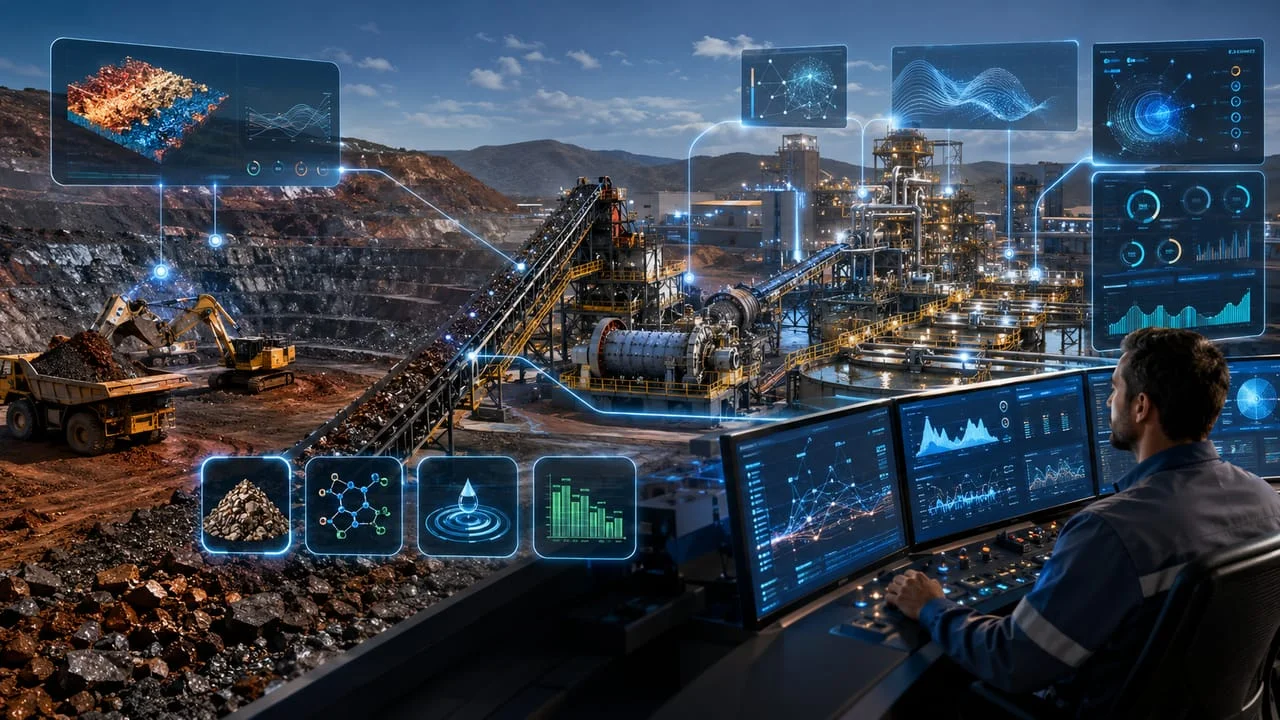
AI in processing plants has become a strategic solution for operations that need to deal with the natural variability of ore, reduce reactive decisions, and improve operational efficiency in real time. In consulting, it is common to find the same challenge in mining operations: the ore coming from the mining front is inherently heterogeneous. This happens because the levels of iron, silica, alumina, and other critical elements vary according to the mined block, local lithology, and extraction conditions.
Although this variability is expected, the main problem lies in the fact that most plants still operate reactively. In this model, the laboratory analyzes the samples, the results arrive with a delay, known as lag , and the blending correction occurs only when the variable material is already being processed. Consequently, in operations with strict specifications, this interval can result in commercial penalties and rework.
To reverse this scenario, it is necessary to implement solutions capable of transforming the plant's operational logic, migrating from a reactive model to a predictive and highly efficient approach.
AI as a real-time grade predictor
One of the ways to achieve this transformation is to eliminate existing silos between geological, chemical, and operational data. Through models that act as grade predictors, AI in mineral processing plants allows for the use of real-time information to anticipate plant behavior even before the material physically reaches the process.
Using Machine Learning models and, in specific applications such as flotation, physics-informed models, which combine data with laws of physics, the system is capable of predicting:
Feed, concentrate, and tailings grade;
Expected metallurgical recovery;
Impact of critical variables, such as particle size, pH, flow rate, reagent dosage, pulp density, and mill power.
This anticipation capability allows for the integration of technologies such as Computer Vision and belt sensors to identify, in motion, variations in particle size and the presence of contaminants. Thus, the operation is better prepared for the incoming load.ação para a carga que está por vir.
Decision support: AI as an operational recommender
More than just predicting scenarios, artificial intelligence can also act as an operational recommender . Because of this , the operation no longer depends exclusively on fixed recipes or manual adjustments based on historical data. Instead , the system suggests optimized setpoints, allowing operators to act with greater precision.
Additionally , these recommendations can support different fronts of the operation. For example , they can guide:
Input adjustment: increase or reduction of reagent dosage and changes in water flow;
Equipment control: adjustment of rotation, circulating load, or valve opening;
Blending strategy: modification of the proportions between ores from different fronts to achieve the target grade;
Operational prioritization: adaptation of process conditions to favor, according to the shift goal, the grade or metallurgical recovery.
Still , an important aspect of this architecture is that the operator maintains final control over decisions. That is , AI does not replace human experience. On the contrary , it provides recommendations that professionals validate before any execution in the plant. In this way , the operation gains agility, precision, and safety, without losing technical control over the process.
The impact on results
AI in mineral processing plants also strengthens the predictability of the operation by connecting data from sensors, laboratories, mine planning, and process parameters. With this integration, the plant starts identifying deviations further in advance and adjusting its decisions before ore variability compromises grade, metallurgical recovery, or operational efficiency..
Quality and compliance
Reducing grade variability contributes to decreasing the occurrence of out-of-specification products, reducing the risk of commercial penalties.
Productivity
By increasing metallurgical recovery, the plant avoids losing valuable ore in the tailings due to process inefficiencies.
Sustainability and costs
The operation becomes more efficient in the consumption of reagents, water, and electricity, promoting economic and environmental gains.
Operational agility
Greater agility in decision-making allows for quick responses to ore variations and keeps the operation more stable.
Strategic alignment
The integration between planning and execution improves the reconciliation between what the mine predicted and what the plant actually produces.
Technical challenges and lessons learned
The implementation of this technology requires overcoming challenges that go beyond algorithm modeling. Among the main ones are:
- Data quality: dealing with the uncertainties inherent in geological drilling models.
- Integration latency: synchronizing instantaneous data from sensors with laboratory results that can take hours to become available.
- Feedback loop: creating continuous update mechanisms to avoid loss of model accuracy over time ( model drift ).
A new operational logic for plants
Mais do que um avanço tecnológico, o ajuste de teor com IA representa uma mudança de paradigma operacional. Ao conectar dados que antes estavam isolados e transformá-los em recomendações acionáveis, a usina deixa de operar como uma “caixa-preta” reativa e passa a atuar como uma unidade de produção inteligente e adaptável.[mineração 4.0]
In this context, chemical stability and operational efficiency are no longer difficult goals to achieve and become part of the natural behavior of the production process.
Content written by Marcelo Lois , LUZA
Continue exploring.

The new engineering of the software-defined vehicle
Automotive engineering is undergoing a change that goes beyond electrification. Increasingly connected and software-dependent vehicles are bringing together areas that, for a long time, worked more independently.
Read article
Data quality in digital transformation
Automation, artificial intelligence, analytics, and systems integration have advanced rapidly within companies. Still, many digital transformation initiatives continue to face a less visible problem: the quality of the data that alim
Read article
Soft skills in the first 30 days of engineering projects
In engineering projects, it is still common to treat soft skills as a secondary differentiator. In practice, the first 30 days show the opposite. It is during this period that it becomes clear if the professional can transform technical knowledge into contribu
Read article
Does your company face a similar challenge?
Talk to our experts about the capabilities and delivery model best suited for your project.